
We built Zvolv with people.
We’re building Zinie to scale the knowledge of those people.
The Linear Model Doesn’t Work for a $10,000 Problem. Enterprise software has always followed the same shape. BRD. Design. Build. Test. Deploy. Improve. One step, then the next, then the next.
That works fine when the problem is big enough to justify the time. A million-dollar transformation can absorb months of discovery. A large implementation team makes sense when the stakes are high enough.
But most problems aren’t that big.
A lot of them are $10,000 problems. Or $20,000 problems. Real, painful, important to the business — but nowhere near large enough to justify a linear, months-long journey from requirements document to go-live.
For those customers, software needs to behave like a commodity. Fast to get. Fast to use. Fast to change. Not a project. A purchase.
You cannot deliver that with a linear model. You have to break the line.
Why We Stopped Thinking in Steps
For more than a decade, our forward-deployed engineers have sat with enterprise teams understanding the business, mapping the exceptions, designing the solution, building it, deploying it, staying to improve it. It works. It’s also how Zvolv became what it is. Every implementation taught us something. Every exception became a pattern. Every integration became a reusable capability.
But you can’t put an engineer next to every business in the world. And a linear process however good the people running it has a floor on how fast it can go, because each step waits for the one before it.
So instead of asking “how do we do the same steps faster,” we asked a different question: what if the steps didn’t have to happen in order at all?
The Non-Linear Model
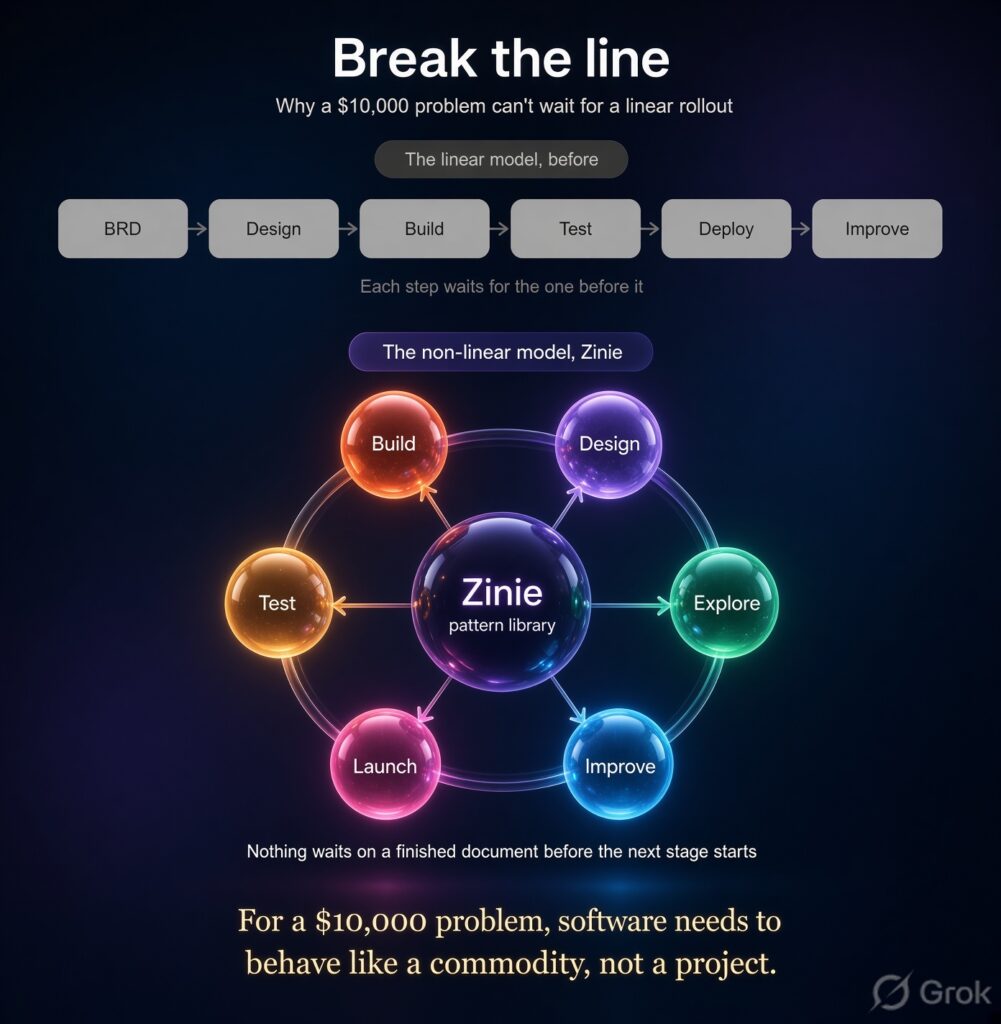
That’s what we’re building into Zinie.
Instead of starting at requirements and walking forward, Zinie starts by asking what we already know. Hundreds of implementations have already produced approval workflows, case management, document processing, dashboards, integrations, data models, automation, AI agents and full solution templates for problems that repeat across industries.
When a new problem comes in, Zinie isn’t gathering requirements in isolation and then designing in isolation and then building in isolation. It’s pulling from that library, understanding what’s different about this specific business, and composing a solution discovery, design, and build happening together, not one after another.
That’s the non-linear part. Nothing waits for a document to be finished before the next stage can start. The pattern library and the reasoning happen in parallel with understanding the customer, so what used to be a sequence becomes closer to a single motion.
What This Changes
Two ways this plays put
The clearest way to see the difference between the old model and the new one is to look at two real examples side by side.
Examples
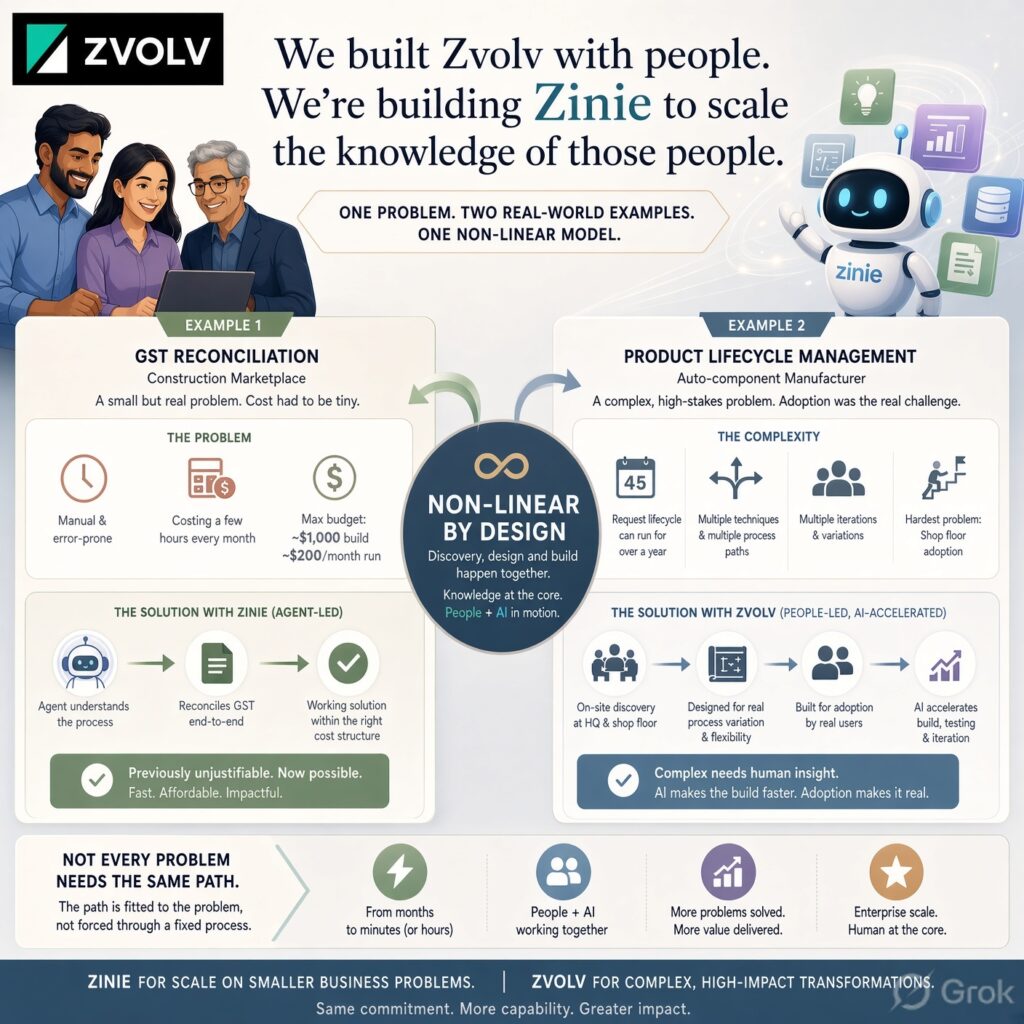
- The first is a GST reconciliation use case we built for a construction marketplace, and it is a good illustration of the small, agent-led end of the spectrum.
The business need was genuine. The existing process was manual and error-prone, and it was costing the client a few hours every month. But the economics were unforgiving. There was no way to justify the ROI if the solution cost more than about a thousand dollars to build, or more than a couple hundred dollars a month to run. This is exactly the kind of problem that used to fall through the cracks, not because it did not matter, but because no traditional implementation model could touch it profitably. With an agentic approach, it stopped being a tradeoff. The agent handled the reconciliation logic end to end, and the client got a working solution inside a cost structure that would never have supported a human-led build. That is the whole point of the non-linear, agent-first model: it makes previously unjustifiable problems solvable.
- The second is a product lifecycle management solution we built for an auto-component manufacturer, and it sits at the other end of the spectrum entirely.
This plant had already tried other software and had been burned by it, so there was real reluctance going in. They partnered with Zvolv, and our team spent several days on site, at their headquarters and on their shop floor, gathering artefacts and understanding how work actually happened. The complexity here was not something an agent could shortcut. A single request could run through its lifecycle for over a year, with multiple iterations along the way. Manufacturing itself was not one fixed process. There were multiple techniques and multiple process paths, and more than one of them could apply to the same request depending on context. And the hardest problem was not technical at all. It was adoption. Getting the shop floor to actually use the application was the real challenge. We designed the entire solution around that reality, and gave them the flexibility to handle their own process variation rather than forcing them into a rigid template.
Put together, these two examples say something important about how we think about delivery.
Speed is not the same thing everywhere, and it should not be forced to be.
For a well-defined, cost-sensitive problem like the GST reconciliation case, the agent can carry the whole process, and the result is a solution that simply would not have existed under the old economics. For a complex, high-stakes problem like the PLM rollout, the value is still in people who can sit on a shop floor, absorb a year-long process with all its variation, and design something that real users will actually adopt. The agent’s role there is to accelerate and refine that work, not replace it.
That is the real shape of the non-linear model. It does not mean every problem gets solved the same way. It means the path each problem takes is fitted to the problem itself, instead of being forced through the same fixed sequence of steps regardless of size.
Zinie is launched to offer scale for smaller business problems, more complex models will still be services via Zvolv. No change to that offering – except that AI makes the build process faster
Author – Akilan – Chief Solutions Officer , Zvolv